
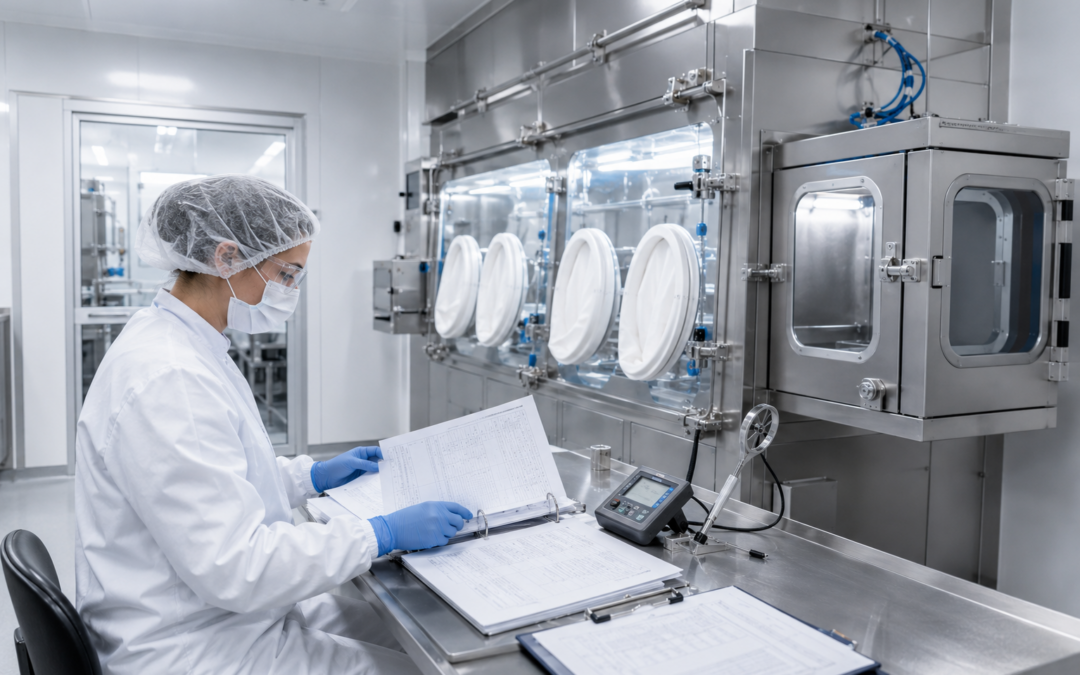
In a GMP-regulated pharmaceutical or biotechnology facility, no piece of cleanroom equipment can be placed into routine production use until it has been formally validated. This requirement is not a procedural formality, it is a regulatory obligation with direct implications for product quality, patient safety, and inspection outcomes. Yet validation is frequently misunderstood, under-resourced, or treated as a documentation exercise rather than a genuine engineering and quality assurance activity.
This article provides a clear, practical explanation of the four qualification phases that constitute cleanroom equipment validation -DQ, IQ, OQ, and PQ – what each phase requires, why it matters, and how the equipment manufacturer’s role in providing supporting documentation determines how efficiently a regulated facility can complete the process.
Why Cleanroom Equipment Validation Is a GMP Requirement, Not an Option
The obligation to validate cleanroom equipment in pharmaceutical manufacturing derives from the core GMP principle that all equipment used in the production of medicinal products must be demonstrated to be fit for its intended purpose before use, and must be maintained in a state of control throughout its operational life.
EU GMP Part I, Chapter 3 (Premises and Equipment) requires that equipment be qualified and that qualification records be maintained. EU GMP Annex 15 (Qualification and Validation) provides the detailed framework for how qualification should be planned, executed, and documented. For sterile manufacturing environments, EU GMP Annex 1 (2022 revision) adds specific requirements for the qualification of cleanroom environments and the equipment that creates and maintains them — including laminar flow hoods, isolators, air showers, fan filter units, and pass boxes.
The regulatory consequence of inadequate equipment validation is severe. During GMP inspections by national competent authorities, the EMA, or the FDA, missing or incomplete qualification documentation for critical cleanroom equipment is a finding that can delay product approval, trigger warning letters, or result in manufacturing site suspension. For facilities producing sterile injectables, advanced therapy medicinal products, or other high-risk product categories, the quality risk associated with unvalidated cleanroom equipment is not theoretical, it is a documented source of product contamination incidents and regulatory enforcement actions.
Validation is also a commercial requirement in an increasing number of B2B contexts. Pharmaceutical contract development and manufacturing organisations (CDMOs) are routinely required to demonstrate equipment validation status as part of customer qualification audits. The absence of DQ, IQ, OQ, or PQ documentation for critical cleanroom equipment can disqualify a facility from a customer audit before the site visit begins.
Design Qualification (DQ): Defining Cleanroom Equipment Requirements Before Purchase
Design Qualification is the first phase of the cleanroom equipment validation sequence, and it is the phase most frequently omitted or abbreviated, a mistake that generates significant rework and cost during the subsequent IQ and OQ phases.
DQ establishes that the equipment specification defined for a piece of cleanroom equipment is appropriate for its intended use, and that the proposed equipment design meets that specification. The starting point for DQ is the User Requirements Specification (URS): a document prepared by the pharmaceutical facility that defines what the equipment must do, in terms of functional performance, material compatibility, regulatory compliance, and operational characteristics.
For a laminar flow hood, the URS might specify: ISO Class 5 at the work surface, HEPA H14 filtration, AISI 304 stainless steel construction, minimum work zone width, maximum noise level, compatibility with defined disinfectants, and compliance with EN ISO 14644-1. For an isolator, the URS might additionally specify positive or negative pressure differential range, glove port configuration, transfer system type, and compatibility with a defined decontamination agent.
The DQ document then maps the proposed equipment design – as described in the manufacturer’s technical specification, drawings, and component documentation – against each URS requirement, confirming that the design meets the specified requirements or identifying gaps that must be resolved before purchase. A well-executed DQ prevents the acquisition of equipment that does not meet regulatory or operational requirements, and creates the documented baseline against which IQ and OQ testing will be conducted.
AGMM TECH supports DQ activities by providing full technical documentation – including equipment specifications, material certificates, component data sheets, and filter certifications – that enables the pharmaceutical facility to complete the design mapping against their URS without requiring extensive additional data collection from the manufacturer.
Installation and Operational Qualification (IQ/OQ) for Cleanroom Equipment
Installation Qualification (IQ) and Operational Qualification (OQ) are the two phases of cleanroom equipment validation that confirm, through documented testing, that the equipment has been installed correctly and operates as specified.
IQ verifies the physical installation: that the equipment has been delivered in the specified configuration, installed in the correct location and orientation, connected to the required utilities (power, compressed air, exhaust), and that all components match the approved design documentation. IQ testing for a laminar flow hood typically includes: verification of equipment serial number and model against purchase order, confirmation of filter type and rating against specification, verification of electrical supply voltage and connection, and confirmation that the installation location matches the approved facility drawing. IQ is primarily a documentation and physical inspection exercise, but the rigour with which it is executed determines the traceability of the installed equipment to its qualification baseline.
OQ verifies that the installed equipment operates within its specified performance parameters under defined test conditions. For cleanroom equipment, OQ testing typically includes: airflow velocity measurement across the work zone (confirming uniformity and compliance with the specified flow rate), HEPA filter integrity testing (DOP or PAO aerosol challenge confirming H14 efficiency at the installed filter), particle count verification (confirming ISO Class 5 at the work surface), and pressure differential measurement (for isolators and pass boxes with controlled environments). OQ testing must be conducted using calibrated instruments with current calibration certificates, and all test results must be recorded in a format that allows retrospective verification.
The OQ protocol and report, the document that defines what will be tested, the acceptance criteria, and the actual test results, is the core qualification document for cleanroom equipment. Its completeness and accuracy determine whether the equipment can be released for use in production and whether it will withstand regulatory inspection scrutiny.
Performance Qualification (PQ) and Ongoing Monitoring of Cleanroom Equipment
Performance Qualification is the phase of cleanroom equipment validation that demonstrates, under actual or simulated production conditions, that the equipment consistently delivers the environmental performance required for its intended use. PQ moves beyond the controlled conditions of OQ, which is typically conducted in the at-rest state, without production personnel or process activities, to confirm performance in the dynamic, in-operation state.
For a Grade A laminar flow hood used in aseptic filling, PQ includes particle counting during a simulated filling operation with personnel in gowning, process simulation media fills conducted under the Grade A conditions provided by the hood, and microbiological environmental monitoring confirming that viable contamination action limits are met during production activity. The PQ provides the evidence that the equipment delivers Grade A conditions not just when it is first installed, but when it is doing the job it was procured to do.
Following successful PQ, ongoing monitoring maintains the validated state of the cleanroom equipment throughout its operational life. For laminar flow hoods and isolators, this includes: periodic airflow velocity measurement (typically annually or after any maintenance that could affect airflow), HEPA filter integrity re-testing at defined intervals, routine environmental monitoring during production, and documented preventive maintenance according to a schedule that ensures continued performance compliance.
Any change to the equipment, replacement of a filter, modification of the fan speed, physical relocation within the facility, or any maintenance that could affect qualification parameters, triggers a change control assessment that determines whether requalification is required and to what extent. The change control process is the mechanism that keeps the validated state of cleanroom equipment current throughout the equipment’s operational life.
How AGMM TECH Supports Customers Through Cleanroom Equipment Validation Phases
AGMM TECH provides a structured documentation package with all cleanroom equipment deliveries, designed to support customers through each phase of the DQ/IQ/OQ/PQ validation sequence without requiring additional data requests to the manufacturer after delivery.
The standard documentation package includes: full equipment technical specification with component list, material certificates (stainless steel grade, gasket materials, filter frame materials), HEPA filter certification with efficiency test data from an accredited laboratory, factory acceptance test (FAT) report confirming pre-delivery functional performance, electrical wiring diagrams, and maintenance and calibration schedule recommendations. This documentation package provides the data required for DQ mapping against the URS, forms the basis of IQ verification, and establishes the performance baseline against which OQ acceptance criteria are set.
For customers working to specific qualification requirements or timelines, AGMM TECH’s technical team is available to review documentation needs and provide supplementary technical data to support the completion of individual qualification phases. This includes clarification of material specifications, filter performance data, and equipment design details that may be required during IQ or OQ execution.
For facilities preparing for GMP inspections or new product introductions, early engagement with AGMM TECH during the equipment specification phase – at the URS and DQ stage – reduces the risk of qualification gaps emerging after delivery and supports a more efficient overall validation timeline.
Conclusion
Cleanroom equipment validation – DQ, IQ, OQ, PQ – is the documented process through which a pharmaceutical or biotech facility demonstrates that its equipment is fit for its GMP-regulated purpose and that the fitness-for-purpose status is maintained throughout the equipment’s operational life. Each phase has a distinct scope, methodology, and documentation output, and the completeness of the overall validation package determines the facility’s ability to defend its manufacturing quality in regulatory inspections and customer audits. The equipment manufacturer’s contribution to this process, through the quality and completeness of the technical documentation provided at delivery, significantly affects the efficiency and cost of the validation programme. AGMM TECH’s documentation approach is designed to support customers through every validation phase with the data they need, when they need it.


