
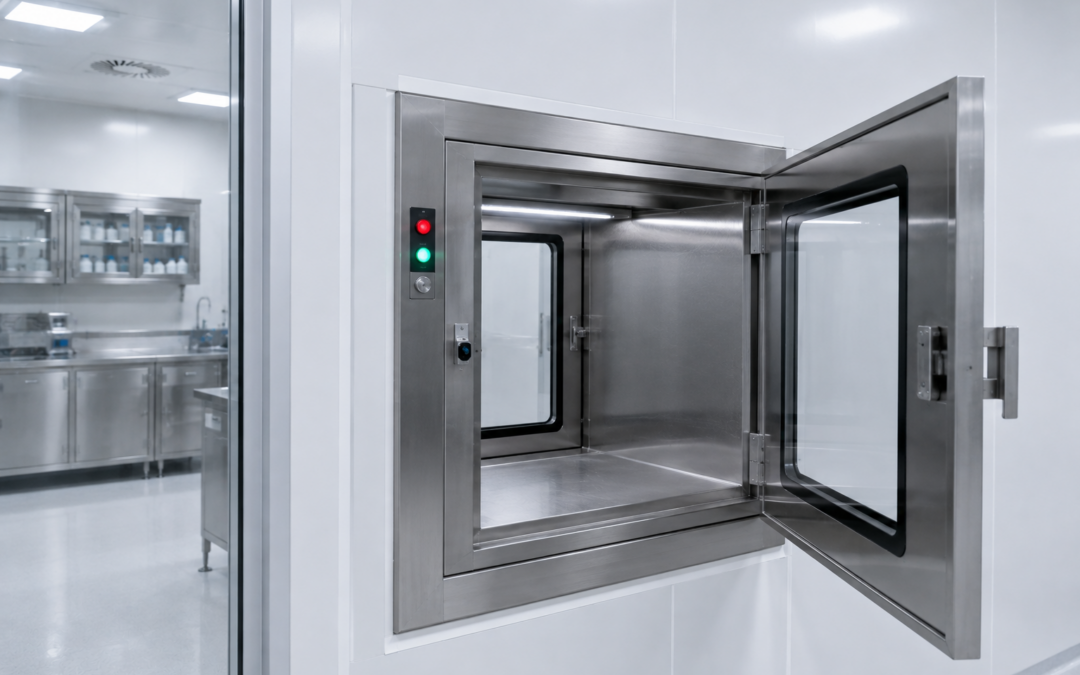
A pass box is a deceptively simple piece of cleanroom equipment. Its function – allowing materials to transfer between two zones of different classification without creating a direct air path between them – depends on a single, non-negotiable condition: the two doors of the chamber must never be open at the same time. The moment both doors are open simultaneously, the pass box ceases to function as a contamination barrier and becomes a direct connection between the cleanroom and the outside environment, or between two classified areas whose separation is the entire purpose of the installation.
The interlock system is the engineering mechanism that enforces this condition, not through operating procedures or operator discipline, but through a physical or electronic control that makes simultaneous opening mechanically or electrically impossible. Understanding how interlock systems work, what options are available, and why they are a regulatory requirement is essential for anyone specifying, purchasing, or qualifying a stainless steel pass box for GMP cleanroom use.
What Is a Mechanical Interlock in a Cleanroom Pass Box?
A mechanical interlock in a stainless steel pass box is a passive, non-electrical system that physically prevents one door from opening while the other is in an open position. The mechanism typically consists of a set of linked rods, levers, or cams – integrated into the door frame and latch assembly – that engage a blocking element on the opposite door when either door is opened. The blocking element can only be released when the first door is fully closed and latched, at which point the second door becomes free to open.
The elegance of the mechanical interlock is its simplicity and reliability. Because it operates without electrical power, it continues to function during power failures, control system faults, or any other condition that would disable an electronic system. There are no sensors to fail, no control boards to malfunction, and no software to update. A properly designed and maintained mechanical interlock will enforce the single-door-open condition as reliably on the last day of its service life as on the first.
Mechanical interlocks are the standard specification for static pass boxes, those without internal airflow, in pharmaceutical, biotech, and food industry cleanrooms where the primary requirement is physical separation between adjacent zones. They are also the preferred specification where electrical infrastructure at the pass box location is limited, or where the facility’s change control and qualification processes make electronic systems difficult to manage.
The limitations of mechanical interlock systems are equally straightforward: they provide no status monitoring, no alarm output, no data logging, and no integration with the facility’s building management system. For applications where real-time status monitoring of the pass box is required, for example, in Grade A aseptic manufacturing areas where environmental monitoring systems must record all events that could affect zone integrity, the mechanical interlock may be supplemented by or replaced with an electromagnetic system.
Electromagnetic vs Mechanical Interlock Systems in Stainless Steel Pass Boxes
Electromagnetic interlock systems use electrically powered locks, typically electromagnetic door holders or solenoid bolt mechanisms, controlled by a logic circuit that monitors the status of both doors simultaneously. When one door is opened, the circuit energises the lock on the opposite door, preventing it from being opened until the first door is returned to the fully closed and latched position and the sensor confirms the closed state.
The control logic for an electromagnetic interlock pass box is typically implemented on a small programmable logic controller (PLC) or a dedicated interlock controller, with door status monitored by magnetic sensors or microswitches embedded in the door frame. The controller can provide digital outputs for status indication, typically LED indicators on a control panel showing which door is locked and which is accessible, and can provide alarm contacts for integration with facility monitoring systems.
The key advantage of the electromagnetic interlock over the mechanical system is its integration capability. A pass box equipped with an electromagnetic interlock and appropriate I/O interfaces can be connected to the facility’s SCADA or BMS, providing real-time status data, event logging, and alarm notification in the event of a fault or an attempted simultaneous opening. For pharmaceutical facilities operating under EU GMP Annex 1 and required to maintain a documented Contamination Control Strategy (CCS), the ability to log pass box access events and demonstrate that zone integrity was maintained throughout a production batch is a significant operational advantage.
The trade-off is complexity. Electromagnetic systems require electrical supply, periodic functional testing of sensors and control logic, and inclusion in the facility’s preventive maintenance programme. A failure of the control circuit can result in either a fail-safe condition, both doors locked, preventing use of the pass box, or a fail-dangerous condition if the system is not correctly designed for safety-critical applications. Specifying a fail-safe electromagnetic interlock, one that locks both doors on power loss rather than releasing them, is a non-negotiable safety requirement for GMP pass box installations.
Why Simultaneous Door Opening Is a Critical Contamination Risk in Cleanroom Pass Boxes
The contamination risk created by simultaneous door opening in a cleanroom pass box is a direct consequence of the pressure differential between the two zones the pass box connects. In a pharmaceutical manufacturing facility, adjacent cleanroom zones are maintained at different pressure levels, typically with the higher-classification zone at a positive pressure relative to the lower-classification zone, so that any air leakage through gaps or connections flows from clean to less-clean, never in the reverse direction.
When both doors of a pass box are open simultaneously, a direct air channel is created between the two zones. If the two zones are at different pressures, air flows through this channel from the higher-pressure zone to the lower-pressure zone, the expected direction. However, the turbulence created by the open doors and any activity at the pass box disrupts the laminar flow patterns in both zones adjacent to the pass box opening, creating bidirectional mixing at the aperture. Particles, bioaerosols, and vapours from the less-controlled zone can be entrained in this turbulent mixing and introduced into the higher-classification zone, regardless of the nominal pressure differential.
In a Grade A / Grade B aseptic manufacturing environment, a single simultaneous door opening event at a pass box connecting the Grade B area to an external corridor represents a potential contamination incident that must be investigated, documented, and assessed for impact on any product that was in the Grade A zone during the event. Depending on the environmental monitoring data and the nature of the materials being transferred at the time, the event may require batch rejection, a cleaning and requalification cycle, or regulatory notification. The cost of a single uncontrolled simultaneous door opening, in production loss, investigation time, and regulatory risk, far exceeds the cost of the interlock system that prevents it.
Regulatory Requirements for Interlocked Cleanroom Transfer Chambers
The requirement for interlocked doors in cleanroom pass boxes is not an industry convention, it is a documented regulatory expectation referenced in multiple GMP guidelines and standards.
EU GMP Annex 1 (2022 revision) references the use of interlocked transfer systems as part of the contamination control infrastructure for sterile manufacturing facilities. The requirement is implicit in the broader expectation that material transfer between classified zones must be managed in a way that preserves zone integrity, a requirement that cannot be met by a pass box without an effective interlock system.
The WHO Good Manufacturing Practices guidelines for sterile pharmaceutical products explicitly state that pass-through hatches should be equipped with interlocking doors. The US FDA’s Guidance for Industry on Sterile Drug Products produced by Aseptic Processing similarly references interlocked doors as the expected standard for transfer chambers between classified areas.
ISO 14644-4 (Design, construction, and start-up) provides guidance on the design of cleanroom facilities including transfer systems, and the interlock requirement for pass boxes is consistent with the standard’s broader approach to contamination control through engineering rather than procedural controls alone.
From a qualification perspective, the interlock system is a critical functional element of the pass box and must be tested as part of the Operational Qualification (OQ). The OQ test for the interlock should verify: that the second door cannot be opened when the first is open, that the interlock engages reliably across multiple cycles, and – for electromagnetic systems – that the fail-safe condition is correctly implemented and that alarm outputs function as specified.
AGMM TECH Passbox Interlock Designs for GMP Cleanroom Compliance
AGMM TECH manufactures stainless steel pass boxes in both static and dynamic configurations, with mechanical and electromagnetic interlock systems available across the full product range. All pass boxes are constructed from AISI 304 scotch brite satin stainless steel with fully TIG-welded construction and no internal mechanical joints on product-contact surfaces, the construction standard required for GMP-compliant material transfer chambers.
The mechanical interlock system used in AGMM TECH static pass boxes is integrated into the door frame and latch assembly, providing reliable passive prevention of simultaneous door opening without electrical supply. The interlock mechanism is designed for cleanroom service, accessible for inspection and maintenance without requiring partial disassembly of the chamber, and is constructed from corrosion-resistant materials compatible with the disinfectants used in pharmaceutical cleanroom environments.
The electromagnetic interlock option provides door status indication via LED panel, with potential-free contact outputs for integration with facility BMS or environmental monitoring systems. The control system is configured as fail-safe: a power loss results in both doors locking, preventing use of the pass box until supply is restored. Functional testing of the electromagnetic interlock is supported by AGMM TECH’s IQ/OQ documentation package, which includes the test protocols and acceptance criteria required for qualification of the interlock system as a critical functional element of the pass box.
For dynamic pass boxes – those with HEPA-filtered internal airflow – the interlock system is integrated with the airflow control logic, ensuring that the fan operates during the transfer cycle and that the door status is coordinated with the filtration system performance. AGMM TECH’s technical team is available to advise on interlock configuration based on facility pressure differential mapping, GMP classification requirements, and BMS integration specifications.
Conclusion
The interlock system in a stainless steel pass box is not an optional feature or a procedural backup, it is the primary engineering control that makes a transfer chamber a genuine contamination barrier rather than a gap in the cleanroom envelope. The choice between mechanical and electromagnetic interlock designs depends on the monitoring requirements, integration needs, and qualification obligations of the specific installation. In either case, the interlock must be specified, installed, and qualified as a critical functional component of the pass box, with documented test evidence that it performs its contamination prevention function reliably under all foreseeable operating conditions. AGMM TECH’s pass box range provides both interlock configurations in GMP-compatible stainless steel construction, supported by the qualification documentation that regulated pharmaceutical and biotech facilities require.


