
In pharmaceutical manufacturing, the Grade A cleanroom environment represents the highest level of environmental control achievable in a production setting. It is the standard applied to the most critical operations in aseptic manufacturing – the filling of sterile products, the closing of containers, the preparation and handling of sterile materials – where any lapse in contamination control can result directly in patient harm. For a contaminated injectable product, there is no safety net: the drug bypasses all of the body’s natural defences and is introduced directly into the bloodstream or tissue.
Understanding what Grade A means, how it is defined under current GMP requirements, and what engineering controls are needed to achieve and sustain it is essential knowledge for pharmaceutical manufacturers, quality assurance professionals, and facility designers working in sterile and aseptic manufacturing environments. This article provides a comprehensive technical overview, grounded in EU GMP Annex 1 requirements and focused on the practical equipment decisions that determine whether a Grade A zone performs as specified.
What Is Grade A and Why It Is the Most Stringent Cleanroom Classification
The EU GMP cleanroom classification system defines four grades – A, B, C, and D – based on airborne particle concentrations measured under defined conditions. Grade A is the most stringent, requiring the lowest particle counts and the highest level of environmental control. The grade designations are applied to specific manufacturing operations based on their contamination sensitivity, with Grade A reserved for the operations that directly contact sterile product or its primary container.
The particle limits for a Grade A cleanroom environment are: a maximum of 3,520 particles per cubic metre at ≥ 0.5 µm, and a maximum of 20 particles per cubic metre at ≥ 5.0 µm, both at rest and in operation. These limits are identical to ISO Class 5 under ISO 14644-1. The equivalence is important: it means that Grade A performance must be verified using the particle counting methodology and statistical sampling requirements of ISO 14644-1, and that the limits apply continuously during production, not just during the qualification exercise.
Grade A is always located within a Grade B background environment. The Grade B room surrounds the Grade A zone and provides a secondary containment layer, it has particle limits of 3,520 per cubic metre at ≥ 0.5 µm at rest, rising to 352,000 per cubic metre at ≥ 0.5 µm in operation. This at-rest to in-operation differential reflects the expected particle generation from personnel activity during production, and the Grade B background is typically achieved and maintained through a combination of high-efficiency filtration, unidirectional airflow, and strict gowning procedures.
The microbial action limits for Grade A are equally stringent: less than 1 colony-forming unit per cubic metre of air, less than 1 CFU per 100 cm² on contact plates, and less than 1 CFU per glove in personnel monitoring. These limits are action limits, their exceedance triggers an investigation and corrective action, rather than alert limits with a graduated response.
GMP Annex 1 Requirements for Grade A Cleanroom Zones
EU GMP Annex 1, the guideline governing the manufacture of sterile medicinal products, was substantially revised in 2022, with the updated version entering into force in August 2023. The revision introduced several requirements directly relevant to the design and management of Grade A cleanroom environments.
The most significant new requirement is the formal obligation for a documented Contamination Control Strategy (CCS). The CCS is a facility-wide risk assessment and control plan that identifies contamination hazards at every step of the manufacturing process and specifies the engineering, procedural, and monitoring controls used to address them. For Grade A zones, the CCS must demonstrate how the Grade A environment is achieved, maintained, and verified, and must address the response to any monitoring data that indicates a deviation from the expected performance.
The 2022 revision also strengthened the requirements around the use of isolators and RABS (Restricted Access Barrier Systems) for Grade A operations. Annex 1 now explicitly states a preference for isolators over conventional open Grade A zones where technically feasible, on the grounds that isolators provide a higher level of contamination control by physically separating the operator from the product-critical zone. Where a conventional Grade A laminar flow environment is used instead of an isolator, the justification for this choice must be documented in the CCS.
The annex also updated requirements for the qualification and ongoing monitoring of Grade A zones, including more detailed expectations for environmental monitoring programmes, data trending, and the frequency of requalification activities. The documentation requirements for Grade A environments have increased in scope and specificity, reflecting the greater emphasis on quality risk management that characterises the 2022 revision as a whole.
Equipment Needed for a Grade A Cleanroom Environment: Laminar Flow Hoods, Isolators, HEPA H14 Filters
Achieving ISO Class 5 / Grade A conditions at the product-critical work zone requires a specific combination of engineering controls. The choice between the main equipment options, laminar flow hoods and isolators, depends on the nature of the manufacturing process, the scale of production, and the level of contamination control that the process risk assessment demands.
Laminar flow hoods, also referred to as laminar flow units, LAF units, or Grade A workstations, create a localised Grade A environment through the continuous delivery of HEPA-filtered air in a unidirectional downward flow over the work surface. The ISO Class 5 conditions within the hood are maintained as long as the airflow is operating correctly and the front opening is not disturbed beyond the validated sash position. Laminar flow hoods are the appropriate choice for filling operations, aseptic assembly tasks, and materials handling steps where operator access to the work zone is required and a fully enclosed isolator cannot accommodate the process.
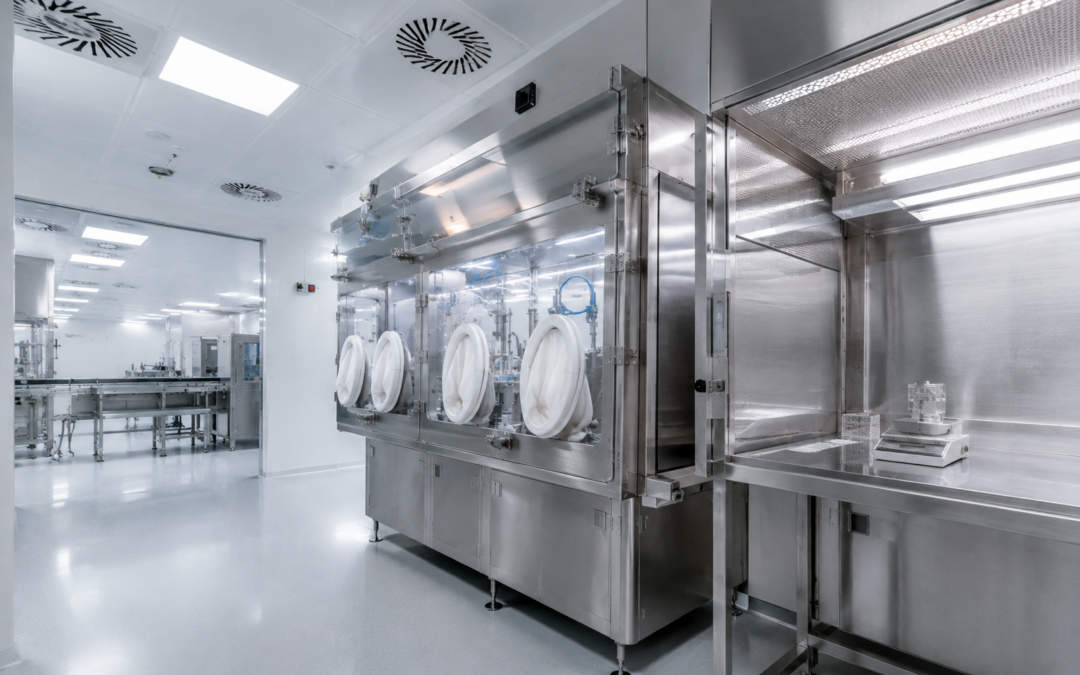
Isolators take the Grade A concept further by completely enclosing the product-critical zone within a rigid barrier, with operator access only through glove ports and material transfer only through validated transfer systems, typically pass boxes or transfer isolators with defined decontamination cycles. The enclosed environment of an isolator can be maintained at a significantly higher level of contamination control than an open laminar flow hood, because personnel activity – the primary source of viable contamination in aseptic manufacturing – is physically excluded from the product zone. Isolators are the preferred solution under GMP Annex 1 for the most contamination-sensitive operations, including the filling of parenteral products and the preparation of advanced therapy medicinal products (ATMPs).
HEPA H14 filtration is the minimum filter specification for both laminar flow hoods and isolators used in Grade A applications. At H14 efficiency – 99.995% retention of particles at the most penetrating particle size – HEPA H14 filters ensure that the air delivered to the Grade A zone meets the particle count requirements of ISO Class 5 with a meaningful safety margin. Standard H13 filters (99.95% efficiency) are not adequate for Grade A applications and should not be specified for equipment intended for use in GMP Annex 1-regulated sterile manufacturing.
Monitoring and Qualification of Grade A Cleanroom Environments
The regulatory acceptance of a Grade A cleanroom environment is not established at installation, it is demonstrated through a structured qualification programme and maintained through an ongoing environmental monitoring programme that provides continuous evidence of environmental control.
Qualification follows the standard pharmaceutical equipment qualification sequence: Design Qualification (DQ), Installation Qualification (IQ), Operational Qualification (OQ), and Performance Qualification (PQ). For Grade A environments, PQ must include particle counting under operational conditions – with personnel in gowning, equipment running, and the full process simulation in place – to demonstrate that ISO Class 5 limits are maintained during production activity, not just in the at-rest state.
For isolators, qualification additionally includes decontamination cycle validation, demonstrating that the chosen decontamination agent (typically vaporised hydrogen peroxide, VHP) achieves the required log reduction in biological indicator spore populations at all internal surfaces, including those most remote from the decontamination agent delivery point.
Environmental monitoring in Grade A zones covers airborne particle counts, viable airborne contamination (active air sampling), surface contamination (contact plates and swabs), and personnel monitoring (glove prints). Monitoring must be performed continuously or at defined intervals during each production session, and the data must be reviewed against established alert and action limits with a defined escalation process for exceedances.
The 2022 Annex 1 revision placed increased emphasis on data trending: rather than responding only to individual exceedances, facilities are expected to identify trends in environmental monitoring data that might indicate a deteriorating contamination control performance before individual limits are breached. This requires a structured approach to data analysis and review that is documented in the environmental monitoring programme.
AGMM TECH Equipment for Grade A Cleanroom Applications
AGMM TECH manufactures laminar flow hoods and isolators designed and constructed for Grade A cleanroom applications in pharmaceutical, biotech, and ATMP manufacturing environments.
The CF series laminar flow hoods deliver ISO Class 5 / Grade A conditions at the work zone through HEPA H14 filtration and validated unidirectional vertical airflow. All internal surfaces are AISI 304 scotch brite satin stainless steel, TIG-welded with fully radiused internal corners, the construction standard required for surfaces in Grade A zones under GMP Annex 1 and its associated guidance documents. Airflow uniformity is verified at installation, with test reports available as part of the IQ documentation package.
The isolator range covers both positive pressure configurations for aseptic product protection and negative pressure configurations for hazardous compound containment. HEPA H14 filtration is standard on supply and exhaust circuits. Transfer systems, static and dynamic pass boxes with electromagnetic interlocks and optional decontamination cycles, are available as integrated components of the isolator installation, providing validated material transfer into and out of the Grade A zone without compromising its environmental integrity.
Complete qualification documentation – DQ, IQ, OQ support documentation, filter certification, and airflow test data – is available for all AGMM TECH cleanroom equipment, supporting the qualification timelines of pharmaceutical facilities preparing for GMP inspection or product licence application.
Conclusion
A Grade A cleanroom environment is not defined by the equipment specification alone, it is defined by the combination of engineering controls, validated qualification, and ongoing environmental monitoring that together provide continuous, documented evidence of contamination control at the ISO Class 5 level. The 2022 revision of GMP Annex 1 has raised the bar for how that evidence must be generated, documented, and managed. Laminar flow hoods and isolators equipped with HEPA H14 filtration, built to GMP-compatible construction standards, and supported by complete qualification documentation are the engineering foundation on which a defensible Grade A programme is built. AGMM TECH’s equipment range addresses each of these requirements with the construction quality and documentation support that regulated pharmaceutical manufacturing demands.


