
Hospital pharmacies occupy a unique position in the healthcare system. They are simultaneously clinical departments, regulated manufacturing units, and critical supply chains for treatments that – if contaminated or incorrectly prepared – can cause direct patient harm. The sterile preparations compounded in hospital pharmacy units include total parenteral nutrition, cytotoxic chemotherapy agents, monoclonal antibodies, intrathecal medications, and ophthalmic preparations: products that bypass the body’s natural defences and are administered directly into bloodstream, tissues, or sensitive anatomical sites.
The controlled environment in which these preparations are compounded is not peripheral to the quality of the finished product, it is a fundamental determinant of it. This article outlines the regulatory framework that governs hospital pharmacy cleanrooms across key markets, the specific equipment requirements for sterile and cytotoxic compounding, the physical segregation principles that protect both patient and operator, and the monitoring and documentation obligations that regulated hospital pharmacies must meet.
Regulatory Framework for Hospital Pharmacy Cleanrooms (USP, PIC/S, EU GMP)
Hospital pharmacy compounding is regulated at multiple levels – national pharmacy legislation, medicines agency guidance, and international GMP standards – and the applicable framework varies by country and by the nature of the products being compounded. Understanding which standards apply, and how they interact, is the starting point for any cleanroom equipment specification in a hospital pharmacy setting.
EU GMP provides the most comprehensive and internationally recognised framework for sterile pharmaceutical manufacturing. Annex 1 of EU GMP – covering the manufacture of sterile medicinal products – applies to hospital pharmacy units that prepare sterile products for administration to patients, either on a named-patient basis or in larger batch quantities. The 2022 revision of Annex 1 introduced significant new requirements, including the formal obligation for a documented Contamination Control Strategy (CCS), strengthened expectations for the use of isolators over open Grade A laminar flow environments where technically feasible, and more detailed requirements for environmental monitoring programmes and decontamination cycle validation.
PIC/S (Pharmaceutical Inspection Co-operation Scheme) guidance documents – in particular PE 010, the guide to GMP for medicinal products – are widely adopted by national regulatory authorities in countries that are PIC/S members, including most European countries, Australia, Canada, Singapore, and others. PIC/S guidance on sterile compounding aligns closely with EU GMP Annex 1, providing a consistent international baseline for hospital pharmacy cleanroom requirements.
USP Chapter <797> governs sterile compounding in US pharmacy settings, including hospital pharmacies. The 2023 revision of <797> introduced risk-stratified cleanroom requirements based on the sterility risk category of the compounded preparation, with Category 1 CSPs (compounded sterile preparations with a short beyond-use date) and Category 2 CSPs (longer beyond-use dates) subject to different environmental requirements. Category 2 non-hazardous compounding requires an ISO Class 5 primary engineering control (PEC) – a laminar flow hood or isolator – in an ISO Class 7 buffer room. Category 2 hazardous drug compounding additionally requires a negative pressure room.
USP Chapter <800> governs the handling of hazardous drugs – including cytotoxic chemotherapy agents – in all US healthcare settings. <800> requires that hazardous drug compounding take place in a negative pressure ISO Class 7 buffer room with negative pressure ISO Class 5 compounding aseptic containment isolators (CACIs) or laminar flow hoods with containment ventilation.
For hospital pharmacies serving international patient populations or operating under accreditation frameworks that reference multiple standards, the practical approach is to identify the most stringent applicable requirement for each product category and use that as the design baseline.
Equipment Needs: Hoods, Isolators, Pass Boxes for Hospital Pharmacy Compounding
The primary engineering controls in a hospital pharmacy cleanroom are the devices that create and maintain the Grade A / ISO Class 5 environment at the point of compounding. Three equipment categories – laminar flow hoods, isolators, and pass boxes – form the core of the hospital pharmacy controlled environment.
Laminar flow hoods provide a localised Grade A environment through the continuous delivery of HEPA H14-filtered air in a unidirectional vertical flow over the compounding workstation. For non-hazardous sterile compounding – TPN preparation, antibiotic admixtures, ophthalmic solutions – a positive pressure vertical laminar flow hood provides the ISO Class 5 conditions required at the open product zone. The stainless steel construction of the hood must support the cleaning and disinfection protocols standard in pharmacy environments: isopropyl alcohol wipes between preparations, sporicidal treatments at defined intervals, and UV-C decontamination cycles.
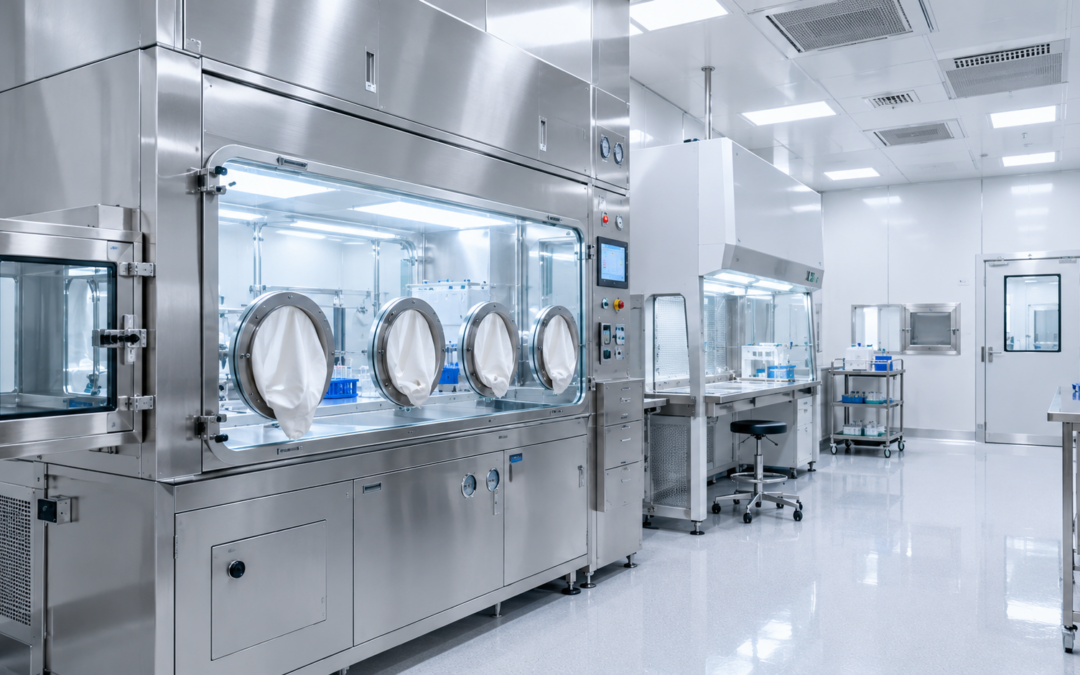
Isolators provide a higher level of protection than open laminar flow hoods for both operator and product. In a positive pressure isolator for non-hazardous sterile compounding, the product-critical zone is physically enclosed and maintained at ISO Class 5 through HEPA-filtered recirculated airflow, with operator access only through glove ports. In a negative pressure containment isolator for cytotoxic compounding, the enclosed environment is maintained at negative pressure relative to the surrounding room, so that any air leakage is inward, preventing drug vapours or aerosols from escaping to the operator’s breathing zone. Isolators are the preferred specification under EU GMP Annex 1 (2022 revision) for aseptic compounding where the process can be accommodated within the isolator’s physical constraints.
Pass boxes manage material transfer into and out of the compounding area without compromising zone integrity. Sterile components, packaging materials, and finished preparations must be transferred between the cleanroom and the surrounding area through a validated transfer system. A static pass box with an electromagnetic interlock – preventing both doors from opening simultaneously – provides a simple and effective transfer barrier for most hospital pharmacy applications. For cytotoxic compounding areas where decontamination of transferred materials is required before exit, a dynamic pass box with UV-C or chemical decontamination cycle capability is the appropriate specification.
Segregation of Cytotoxic vs Non-Cytotoxic Compounding Areas
Physical segregation between cytotoxic and non-cytotoxic compounding areas is a regulatory requirement under all major pharmacy standards frameworks, and its importance extends beyond regulatory compliance to direct patient and operator safety.
Cytotoxic drugs – including alkylating agents, antimetabolites, and monoclonal antibodies classified as hazardous – present a dual contamination risk: they are hazardous to the operator if inhaled, absorbed through skin contact, or accidentally injected, and they represent a contamination risk to non-cytotoxic preparations if cross-contamination occurs. A patient receiving a TPN bag contaminated with residues of a cytotoxic agent would be exposed to a drug with serious adverse effects and no therapeutic indication.
The physical requirements for segregated cytotoxic compounding areas are consistent across EU GMP, USP <800>, and PIC/S guidance: the cytotoxic compounding room must be maintained at negative pressure relative to adjacent areas, so that airflow at any gap or opening is inward. This prevents cytotoxic vapours, aerosols, and surface contamination from migrating to adjacent non-cytotoxic areas. The negative pressure room is supported by a dedicated exhaust system, typically with HEPA filtration of the exhaust air before discharge to the building exhaust, a requirement that the compounding isolator’s exhaust HEPA filter must satisfy.
Personnel workflow between cytotoxic and non-cytotoxic areas must also be segregated. Gowning, gloves, and other personal protective equipment worn in the cytotoxic area must not be carried into the non-cytotoxic compounding zone. Air showers or gowning change areas at the boundary between the two zones enforce this segregation through engineering rather than relying solely on procedural controls.
Monitoring and Documentation Requirements for Hospital Pharmacy Cleanrooms
Environmental monitoring in hospital pharmacy cleanrooms serves two functions: verifying that the controlled environment meets its specified classification at the time of monitoring, and providing a dataset that, when reviewed over time, detects trends indicating a deteriorating environmental control performance before limits are exceeded.
The monitoring programme must cover airborne particle counts, viable airborne contamination (active air sampling), surface contamination (contact plates), and personnel monitoring (glove prints). Monitoring frequency is defined by the classification of the area and the regulatory framework: EU GMP Annex 1 requires continuous or batch-session monitoring for Grade A zones, with defined alert and action limits and a documented escalation process for exceedances. USP <797> specifies monthly viable air sampling for ISO Class 5 PECs and ISO Class 7 buffer rooms under normal operating conditions, with more frequent sampling required following maintenance, personnel changes, or exceedances.
Documentation requirements for hospital pharmacy cleanrooms have increased substantially under the 2022 EU GMP Annex 1 revision. The CCS must be a living document that is reviewed when monitoring data trends indicate a change in environmental control performance, when a significant contamination event occurs, or when facility modifications are made that could affect the controlled environment. Equipment qualification records, DQ, IQ, OQ, PQ for each critical piece of cleanroom equipment, must be maintained and available for inspection, and cleaning and disinfection validation records must demonstrate the effectiveness of the decontamination protocols used in the compounding environment.
AGMM TECH Solutions for Hospital Pharmacy Controlled Environments
AGMM TECH manufactures cleanroom equipment suited to the full range of hospital pharmacy compounding applications, from non-hazardous sterile preparation through to cytotoxic compounding under containment conditions.
The CF series vertical laminar flow hoods, constructed from AISI 304 scotch brite satin stainless steel with TIG-welded construction and HEPA H14 filtration, provide ISO Class 5 conditions for non-hazardous sterile compounding applications. The stainless steel interior is compatible with the full range of pharmacy disinfectants, and UV-C decontamination lamp options are available for inter-preparation decontamination cycles.
The isolator range covers both positive pressure aseptic isolators for sterile compounding and negative pressure containment isolators for cytotoxic drug preparation. HEPA H14 filtration is standard on both supply and exhaust circuits; exhaust HEPA filter configurations are designed to support the filter integrity testing required for containment verification. Pass boxes, static with electromagnetic interlock, and dynamic with UV-C or chemical decontamination options, are available as integrated components of the isolator installation or as standalone transfer systems.
All AGMM TECH cleanroom equipment is supplied with qualification documentation, filter certification, airflow test data, material certificates, and IQ/OQ support documentation, compatible with the qualification requirements of EU GMP Annex 1, USP <797>/<800>, and PIC/S-aligned national pharmacy regulations. The technical team is available to advise on equipment configuration based on the specific product categories, regulatory framework, and facility layout of individual hospital pharmacy units.
Conclusion
Hospital pharmacy compounding units operate at the intersection of clinical urgency and regulatory rigour. The cleanroom equipment that enables safe sterile and cytotoxic compounding, laminar flow hoods, isolators, pass boxes, must meet the highest GMP and pharmacy standards while supporting the throughput and operational flexibility that hospital pharmacy practice demands. Physical segregation between cytotoxic and non-cytotoxic areas, comprehensive environmental monitoring, and complete qualification documentation are not optional enhancements but baseline regulatory obligations across EU GMP, USP, and PIC/S frameworks. AGMM TECH’s cleanroom equipment range provides the technical performance, GMP-compatible construction, and documentation support that hospital pharmacy controlled environments require.


