
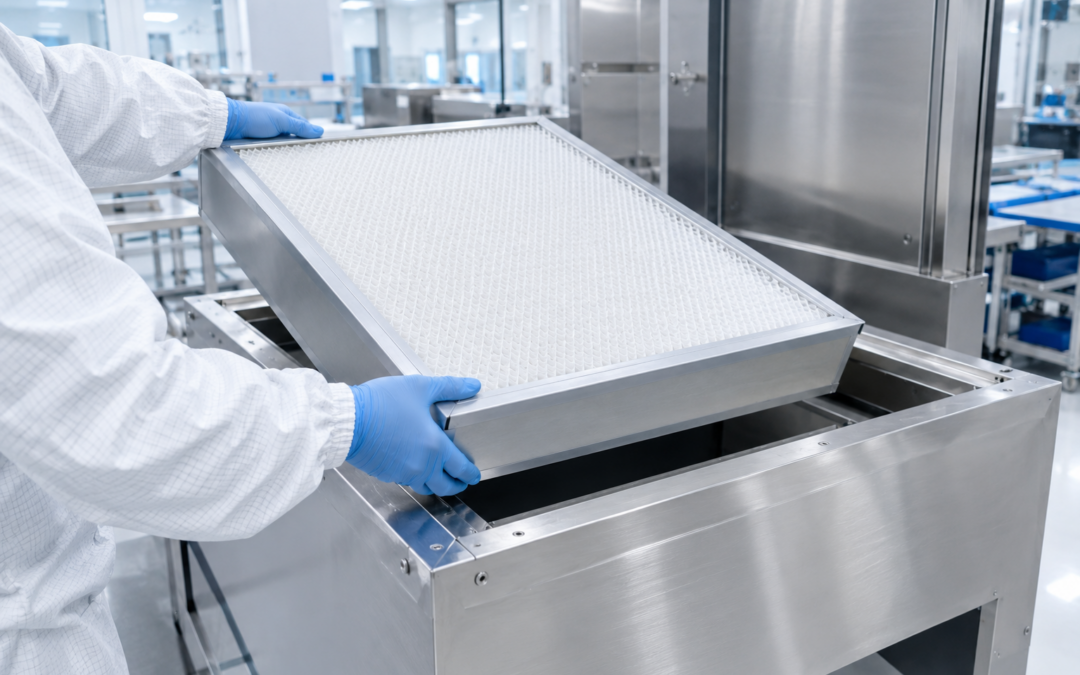
Every cleanroom relies on filtration. The quality of the air delivered to a controlled environment, and the reliability with which that quality is maintained, depends entirely on the specification and performance of the filters installed in the ventilation and recirculation systems. Among the filter classes used in pharmaceutical, biotech, semiconductor, and laboratory cleanrooms, HEPA H14 is the specification most frequently cited in GMP guidelines, ISO standards, and equipment qualification documents. Yet the technical meaning of H14, what efficiency it represents, how it is tested, and when it is required rather than merely preferred, is frequently misunderstood or inadequately specified.
This article provides a complete technical explanation of the HEPA H14 filter standard, its position within the broader filter classification system, and its specific relevance to the cleanroom equipment categories in which it is most commonly deployed.
Filter Classes Explained: From H10 to U17
The classification of high-efficiency air filters used in cleanroom and pharmaceutical applications is defined by EN ISO 29463, which superseded the earlier EN 1822 standard and harmonised European filter classification with the ISO framework. The standard defines a hierarchy of filter classes based on their efficiency at the most penetrating particle size (MPPS), the particle diameter at which a given filter type provides its lowest collection efficiency, and therefore the most stringent test of filter performance.
The classification system runs from E10 to U17, covering efficiency levels from 85% to greater than 99.999995%:
EPA filters (E10–E12) are efficiency particulate air filters with efficiencies ranging from 85% to 99.5% at MPPS. These are used in pre-filtration stages and in applications where high-efficiency absolute filtration is not required, general ventilation systems, pre-filters upstream of HEPA stages, and air handling units in non-classified areas.
HEPA filters (H13–H14) are high-efficiency particulate air filters. H13 achieves a minimum efficiency of 99.95% at MPPS, while H14 achieves 99.995%. The distinction between H13 and H14, a factor of ten in particle penetration, is significant in regulated environments where the margin between passing and failing a particle count test is narrow.
ULPA filters (U15–U17) are ultra-low penetration air filters, with efficiencies ranging from 99.9995% to 99.999995% at MPPS. ULPA filters are specified for the most demanding semiconductor fabrication environments, where particle control requirements at sub-100 nm sizes make even H14 efficiency insufficient.
The MPPS for glass fibre filter media, the material used in both HEPA and ULPA filters, falls in the range of approximately 0.1 to 0.3 µm, depending on the specific media formulation and face velocity. This is the particle size range at which the mechanisms of filtration, inertial impaction, interception, and diffusion, are least effective. Particles either larger or smaller than the MPPS are captured more efficiently than those within the MPPS range. A filter rated at H14 efficiency therefore provides 99.995% capture at this worst-case particle size, and higher capture efficiency at all other sizes.
What H14 Efficiency Means in Practice (99.995% at MPPS)
An H14 HEPA filter captures 99.995% of airborne particles at the most penetrating particle size. Expressed in terms of penetration, the fraction of particles that pass through the filter, this means that 0.005% of MPPS particles penetrate to the downstream side. For every one million particles at the MPPS presented to the filter face, fifty pass through.
To contextualise this figure: a standard room air supply might contain particle concentrations in the range of 10⁶ to 10⁷ particles per cubic metre at ≥ 0.5 µm. After passage through an H14 HEPA filter, the downstream concentration at these particle sizes is reduced to the range required for ISO Class 5 (Grade A) conditions, a maximum of 3,520 particles per cubic metre at ≥ 0.5 µm. The filter’s efficiency directly determines whether the downstream air quality meets the ISO classification requirement.
The practical implication of the H13 versus H14 choice is most visible in applications where the upstream particle concentration is high and the downstream particle count limit is tight. In a laminar flow hood operating in a Grade B background environment with a particle count of 352,000 per cubic metre at ≥ 0.5 µm (the GMP in-operation limit for Grade B), an H13 filter would deliver a downstream count of approximately 176 particles per cubic metre, within the Grade A limit of 3,520. An H14 filter would deliver approximately 18 particles per cubic metre, a factor of ten lower, providing a substantial safety margin against Grade A exceedances during production activity.
The relevance of this safety margin becomes clear when environmental monitoring data is reviewed over a production campaign. Individual particle count measurements fluctuate around the average, and the safety margin provided by H14 filtration reduces the probability that statistical variation in upstream particle concentrations will produce a downstream reading above the Grade A action limit. This is why EU GMP Annex 1 implicitly requires H14 filtration for Grade A environments, even though the standard does not always specify the filter class explicitly: the Grade A particle limits cannot be reliably achieved with H13 filtration under all in-operation conditions.
When H14 Is Required vs When H13 Is Sufficient
The choice between H13 and H14 HEPA filtration is a risk-based specification decision that depends on the ISO classification of the environment, the nature of the process, and the applicable regulatory framework.
H14 is required for:
Grade A / ISO Class 5 cleanroom equipment, laminar flow hoods, isolators, and mini-environments used in aseptic pharmaceutical manufacturing, sterility testing, ATMP processing, and hospital pharmacy compounding. EU GMP Annex 1 expectations, the specific Grade A particle limits, and the safety margin analysis outlined above all point to H14 as the appropriate specification. Grade A applications in semiconductor fabrication at ISO Class 5. Biosafety cabinet applications where the exhaust HEPA filter must prevent any viable organism from passing to the room environment, the H14 efficiency provides an additional safety margin over H13 in biological containment applications.
H13 may be sufficient for:
ISO Class 6 to ISO Class 8 cleanroom environments where the upstream particle load is lower and the downstream limits are less stringent. General laboratory laminar flow hoods used for product protection in non-GMP research environments. Pre-filtration stages upstream of a terminal H14 filter, where the H13 pre-filter extends the service life of the terminal filter by capturing the bulk of the coarser particle load.
The decision between H13 and H14 should always be documented as part of the equipment URS and DQ process. Specifying H13 for a Grade A application to reduce equipment cost, and then attempting to justify the choice during a GMP inspection, is a risk that the savings in filter cost do not justify.
Testing and Certification of HEPA H14 Filters in Installed Systems
A HEPA H14 filter’s efficiency rating is established by the filter manufacturer at the time of manufacture, using a standardised aerosol challenge test conducted in a controlled factory environment. The test confirms that the filter element meets the H14 efficiency specification before it leaves the factory. However, the in-situ performance of the filter after installation in cleanroom equipment, and after months or years of service, is a separate question that requires on-site testing.
In-situ HEPA filter integrity testing, also called leak testing or DOP/PAO testing, involves generating an aerosol upstream of the installed filter and scanning the downstream face of the filter and its frame seals with a photometer or particle counter. The test detects leaks at the filter media, at the filter frame, and at the seal between the filter frame and the equipment housing, all points at which the rated efficiency of the filter can be compromised by installation damage, inadequate sealing, or frame distortion during service.
EN ISO 29463-5 defines the test methods for in-situ filter testing, including the aerosol type (typically PAO or DEHS), the challenge concentration, the scanning methodology, and the acceptance criteria. For H14 filters, the local penetration limit, the maximum penetration detected at any point during the scan, is 0.005%, consistent with the H14 overall efficiency specification. Any leak that produces a local penetration above this limit requires corrective action: resealing the filter frame, replacing the filter, or investigating the source of the leak in the equipment housing.
The frequency of in-situ filter integrity testing for pharmaceutical cleanroom equipment is defined by the facility’s qualification programme and periodic requalification schedule. Annual testing is typical for critical applications, with additional testing triggered by any maintenance event that could affect filter integrity, filter replacement, equipment relocation, or any physical impact on the filter housing.
AGMM TECH Use of H14 Filters in Hoods, Isolators, and FFUs
HEPA H14 filtration is the standard specification across the complete AGMM TECH cleanroom equipment range, applied uniformly to laminar flow hoods, positive and negative pressure isolators, fan filter units, air showers, and dynamic pass boxes.
In the CF series laminar flow hoods, the H14 supply filter is mounted in a filter housing designed for tool-free filter replacement and accommodates both scan testing and filter bag-in bag-out (BIBO) configurations for hazardous applications where the used filter must be removed without personnel exposure to its captured contamination. Filter frame seals are designed to maintain the full H14 efficiency under the face velocities and differential pressures encountered in normal hood operation, and filter integrity test ports are provided as standard to facilitate in-situ DOP/PAO testing without requiring disassembly of the hood.
In AGMM TECH isolators, H14 filtration is applied to both the supply and exhaust air circuits. The exhaust H14 filter is the final barrier between the isolator’s internal environment, which may contain cytotoxic compounds, viable biological agents, or decontamination agent residues, and the room or building exhaust system. The integrity of the exhaust filter is therefore a containment-critical function, and AGMM TECH’s isolator designs provide the access and test ports required for regular in-situ integrity verification.
Fan filter units from AGMM TECH are supplied with H14 filters as standard, with ULPA options available for semiconductor and other applications requiring efficiency beyond the H14 specification. Filter certification documentation, including the manufacturer’s test certificate confirming H14 efficiency, filter class, and test aerosol, is included in the equipment delivery package as part of the IQ/OQ documentation support provided with all AGMM TECH products.
Conclusion
The HEPA H14 filter is not simply a high-performance consumable, it is a specification decision with direct consequences for cleanroom classification compliance, GMP regulatory acceptance, and the reliability of environmental monitoring data over a production campaign. Understanding the difference between H13 and H14, the conditions under which H14 is required rather than merely adequate, and the in-situ testing requirements that verify ongoing filter performance is fundamental knowledge for anyone responsible for cleanroom equipment specification, qualification, or operation. AGMM TECH’s uniform adoption of H14 filtration across its product range reflects this understanding, providing regulated facilities with a consistent, auditable filtration standard across every piece of cleanroom equipment bearing the AGMM TECH name.


